Think of African landscapes and the chances are you’ll be imagining an endless golden savannah, broken only with twisted and parched acacia trees. The wildebeest are cantering frantically in search of water and fresh grass (this is the main driver of the Great Migration) and vultures float on the thermals hoping to spot a lion kill.
Baby Hippo in the Green season with Norman Carr Safaris
Leopards with Norman Carr Safaris- green season
Lightening in the Luangwa with Norman Carr Safaris- green season
Birding with Norman Carr Safaris- green season
Boat safari with Norman Carr Safaris- green season
There’s another Africa however, the Africa that blossoms with life in and around the rains. The green season (sometimes rather optimistically known as the “emerald season”) transforms the landscape. Rivers burst with life and grasses and trees seem to glow in almost implausibly bright hues. Under thunderous storm clouds young animals learn to stand on shaking legs within minutes of their births, and predators look sleek and happy with a bellyful of food. This is the time when you’ll take the most spectacular photographs and see the bush at its very best (and sometimes at half the price of the peak periods).
Beyond that, the parks are largely deserted, and if you’ve done several safaris it’s utterly fascinating seeing the game reserves in a new light. Birding in particular is utterly glorious- if you’ve never seen a fish eagle swoop for its kill or a finfoot skiddle-skaddle across the water’s surface- this is your moment.
Green season safaris are at their best in Kenya and Tanzania in March and June (catch the savannah with its spring colours) or in Zambia between January and April. The ultimate experience is a boat safari in the South Luangwa– thanks to our friends at Norman Carr for the amazing selection of photos above. Elsewhere, watch the desert spring to life in Namibia, the mighty flood at the Victoria Falls or catch the mini Migration in the Kalahari.
A hundred years ago, the best way to do a safari was on horseback. That way you got to see a little more, and move a little faster than you might if you were on a walking safari, but without the noise and fumes of travelling in a safari vehicle. Fast forward to 2013, when many of us live in cities, and you’re unlikely to find a horse tied up in the back garden. Bikes however, are everywhere.
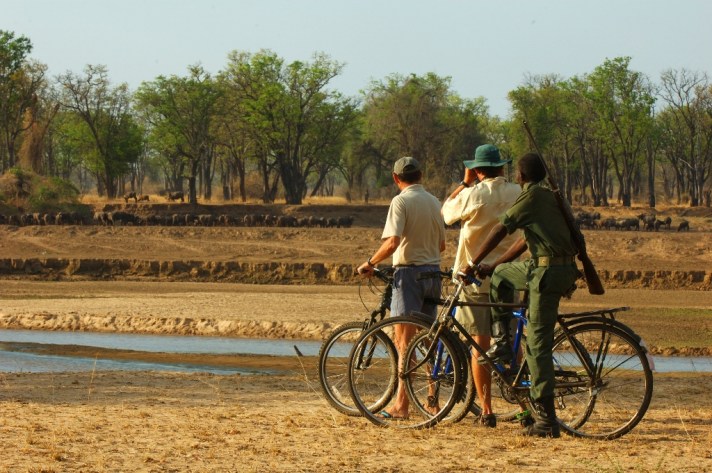
Mountain Bike Safari from Tafika, Zambia
With the cycling craze sweeping Britain, almost every household seems to have a bike or three in the garage or taking up space in the hall. On summer afternoons the country lanes are choked with cycles, and early morning commuter trains are full of Brompton bikes. It almost seems extraordinary that it’s taken till now for mountain bike safaris to take off to such an extent. Now though, a bike or two is the must-have piece of kit in every safari camp. What better way to burn off the endless delicious meals that seem to come almost hourly on safari?
Mountain bike safaris take you from being an outside observer of the bush to being part of it. Race galloping giraffes, smell the dampness of the dust in the early morning, and hear the birds cry as you move silently past. Africa at its best? Absolutely.
Here’s our pick of the very best biking in Africa:
Bush Biking for Beginners: Tafika, Zambia
Tafika, in Zambia‘s South Luangwa National Park was where I fell in love with mountain biking safaris- my first one, and the beginning of a serious addiction.
Cycling through the bush with John Coppinger, 20 years my senior and embarrassingly fitter, was a revelation-we could keep up with the zebras without scaring them, hear every branch crackle underfoot, and really, really appreciate the size of an elephant. I’d recommend as an introduction to anyone- you can just pop out for an hour or so on the bikes before a late afternoon game drive- perfect for dipping your toe in the water.
Multi-day mountain biking: Karisia, Kenya
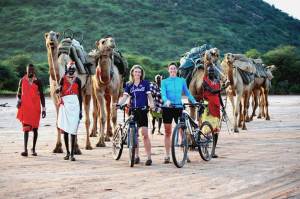
If you’re a serious mountain-biker and love nothing better than getting dusty, dirty, and down with the animals, then a multi-day mountain biking safari could be the answer.
Together with our friends at Karisia in Kenya, we’ve put together a mountain biking safari in the Laikipia plateau in Kenya. We’ve limited it to 3 days of cycling, followed by some time in a vehicle for the saddle-sore, but we can make it as long as you like.- even cycling between safari lodges instead of flying. While we don’t like to gamble, we’re fairly confident that your warrior guides, and the camels who carry your kit, will keep pace with you no matter how long you want to keep pedalling for!
Serious adventure, Serious luxury: Singita Sabi Sand, South Africa
Serious adventure needn’t mean a compromise on serious luxury. If you want the adrenaline thrill of cycling down dusty tracks, watching elephants from the saddle, but don’t want to rough it in the evenings, then Singita Sabi Sands is the perfect solution.
Not only are you smack in some of the best leopard-viewing territory in Africa, at the end of the day you’ll be returning to a seriously lovely room, easily large enough for a London estate agent to describe it as a “spacious, one-bedroom apartment”. These come complete with a decanter of something warm, delicious nibbles and a plunge pool to wash off the dust. Singita has a wine cellar to die for (we made sure to sample it on your behalf when we visited), fantastic guides, and a gorgeous area to explore.
Biking and the beach:
Though we’re huge fans of mountain biking on safari, if you’re just not quite sure about heading into the wilderness on two wheels rather than four, there are some fantastic options for biking that aren’t quite so wild.
A mountain bike is a fantastic way to explore the villages that line the shores of Lake Malawi. Every single visitor that we’ve ever sent on holiday to Malawi has commented on just how warm and friendly the local are. For once it seems that a country really does live up to the tourist board slogan (in this case- the “warm heart of Africa”). Stepping away from the confines of a vehicle is the ideal way to meet the local community, and make hoards of tiny new friends amongst the children of the villages.
Ellies have a special place in my heart. You can keep your lazy lions, and boring buffaloes (though I’m sure anyone who’s been chased up a tree by an angry dugga boy would say they’re far from boring), it’s a sighting of an elephant that makes my safari.
Ellies have by far and away the most character in the animal kingdom, though I make an honourable exception for monkeys – anyone who’s ever had the sugar swiped from their morning coffee, or a triple-zipped tent miraculously burgled, can’t fail to admire their cunning. Back to elephants though. Watch an ellie for ten minutes, and we’d challenge anyone not to start anthropomorphising. I’ve seen them wipe their eyes when they’re tired, and stayed in camps where elephants drank from the outside shower. I mean, why would you bother going all of the way to the lake to drink when the water was suddenly on, and right there? In spite of their huge size, an elephant will tread delicately to avoid the smallest, most irritating stone, and frankly, when the hustle of the wildebeest migration‘s around, you’re unlikely to see too many elephants- why hang about with all of the noise going on?
Best of all, elephant memories are indeed long, and it’s not unusual for an ellie to recognise a familiar face from years ago. While safari guides tell the occasional tall tale (especially when a beautiful girl’s involved) I know at least one straight-talking bush lover who has sat in a vehicle and watched, astonished, as an elephant came racing forward, plunging straight into the vehicle with her trunk. Instead of attacking she felt gently round with her trunk to greet the guide, and returned minutes later, gently nudging her young calf forwards to meet a familar friend.
Have I won you over yet? Ooooh, I do hope so! I once planned a safari for an elephant lover, and if I could do so again, these would be my top picks:
Selous Game Reserve, Tanzania & Lower Zambezi National Park, Zambia
These two glorious parks are both dominated by their rivers, and a late afternoon boat safari is one of the great joys of a visit here. More particularly, the chance to witness elephants crossing the river. Several years ago, on a Tanzanian safari, I watched a family crossing the Rufiji River in the Selous. First came the naughty teenagers- rushing forwards to fill their trunks with water and spraying each other. Then, the nervous babies holding their trunks high to keep breathing. Finally, the mummies, hustling everyone forwards with their trunks and keeping the whole show on the road.
This comes with a serious warning. If you’ve never fallen in love, this could be your moment. The young elephants here have all been tragically orphaned, many by poaching, and all have heart-rending stories. We can add a day in Nairobi into any Kenyan safari, and at 11 each morning you can visit for an hour, watching the ellies as they come out for their morning play. Our top tip? We’d seriously consider fostering an elephant. Not only are you helping to support these tiny, brave little fellows, but also, sponsors are often given the chance to visit again in the afternoon, without all of the other tourists.
Stanley’s Camp, Okavango Delta, Botswana
It’s fair to say that a safari in Botswana doesn’t come cheap, but the chance to walk hand in trunk with an elephant as he goes about his day? Well, as MasterCard might say, priceless. As an added extra to a stay at Stanley’s (if you talk to me, I’ll tell you it’s mandatory), you can spend a morning wandering through the bush -or having lunch- with orphans Jabu, Thembi, and Morula, and their adoptive human parents, Doug and Sandi.
Sadly, we can’t be in Africa all of the time. Well, we could, but the Extraordinary Africa dog is probably a little too small to take on a lion, though he’d like to think he could. When we’re in the UK, we’re keen swimmers- in fact, Alex, our founder, has an ongoing project to swim down the Thames. So needless to say, this article (hiding behind the paywall sadly) from the Sunday Times, caught our interest right away.
But we were sad to see a gaping omission in their list- one of the world’s greatest swimming pools, which re-opened this week: The Devil’s Pool, right on the edge of Zambia’s Victoria Falls. This is not for the faint-hearted, and only opens each year when the water’s low enough – when it’s high, the flow’s powerful enough to sweep an elephant right over the falls. You need to be a strong swimmer- this is definitely on the adventurous end of the spectrum, but it’s as close to Victoria Falls as you’re likely to get!
When is the Devil’s Pool open?
Usually late August/September until Mid-January.
How do I get to the Devil’s Pool?
Take a boat out to Livingstone Island, and follow your guide carefully across the rocks, and he’ll show you exactly where to jump in. We can book this for you, but as it depends so much on the water levels it’s usually best to book with your lodge when you’re there.



 If you’re a serious mountain-biker and love nothing better than getting dusty, dirty, and down with the animals, then a multi-day mountain biking safari could be the answer.
 Serious adventure needn’t mean a compromise on serious luxury. If you want the adrenaline thrill of cycling down dusty tracks, watching elephants from the saddle, but don’t want to rough it in the evenings, then Singita Sabi Sands is the perfect solution.


 EXTRAORDINARY AFRICA